
Facility access
Delta-ENIGMA opens Facility access calls each year until 2032, for proposals to get access to laboratories in the Netherlands.
For researchers worldwide, including the Netherlands:
- Windtunnel at UT. Fieldlab. at University of Twente
- Metronome at Earth Simulation Lab (ESL) at Utrecht University
- Sediment dynamics Facilities, Kraijenhoff van de Leur Laboratory at Wageningen University & Research
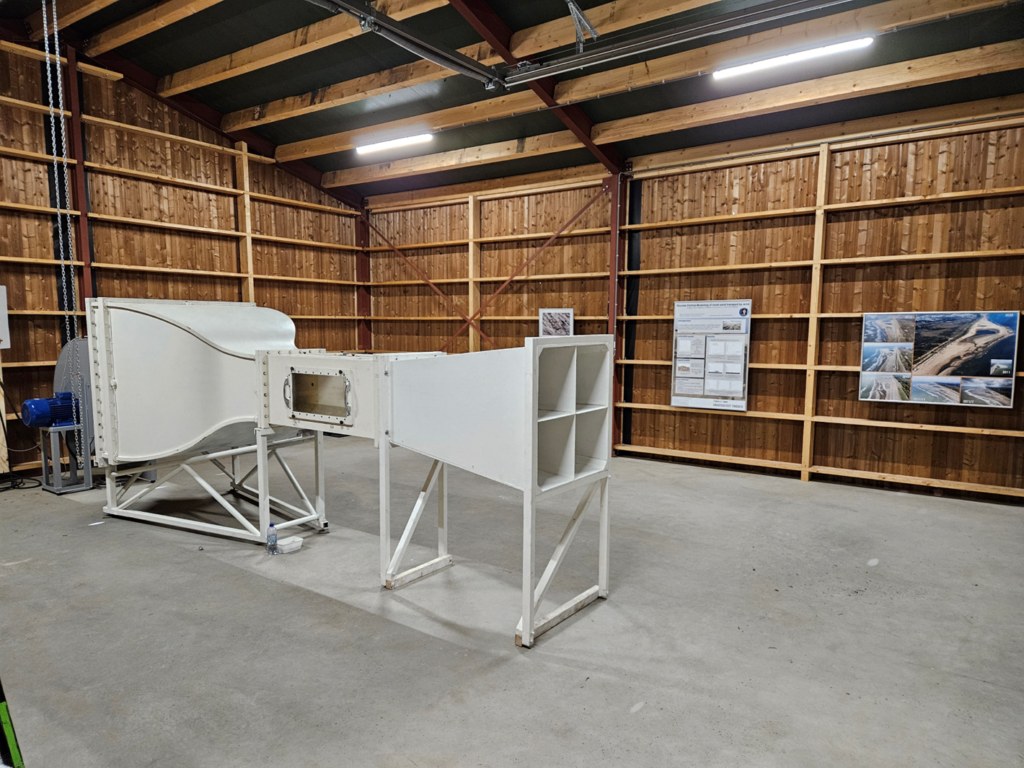
Windtunnel at UT.Fieldlab at University of Twente.
To submit proposal contact: Dr.ir. G.H.P. Campmans (g.h.p.campmans@utwente.nl)
This open-ended wind tunnel is designed to investigate wind-driven sediment entrainment and evaporation processes under controlled conditions, with a particular focus on the influence of moisture on the initiation of sand grain motion in beach and soil environments. The facility features a test section of approximately 0.4 × 0.4 m cross-section and up to 2–2.5 m length, wind speeds ranging from 0 to 20 m/s, and a configurable testbed that can accommodate moist sand, soils, and short vegetation while allowing regulation of substrate moisture content.
Expected applications include studies of threshold wind conditions for sediment transport, grain-scale particle dynamics, and evaporation from moist or vegetated surfaces, supported by instrumentation for airflow, particle tracking, surface temperature, soil moisture, and atmospheric conditions.
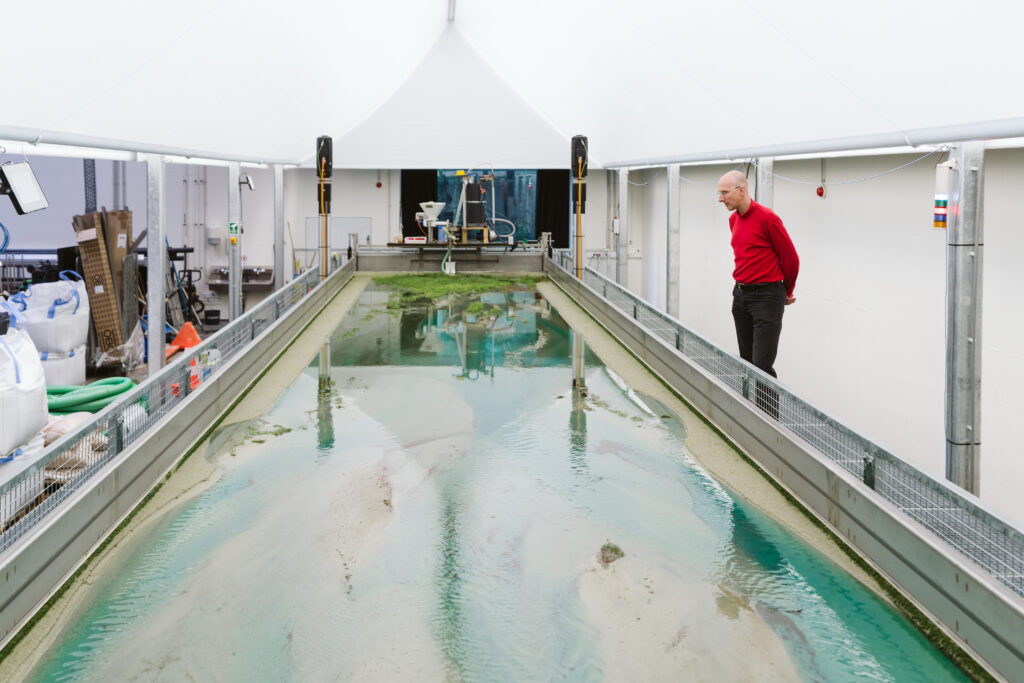
Metronome at Earth Simulation Lab (ESL) at Utrecht University
To submit proposal contact: Prof. dr. Maarten Kleinhans (m.g.kleinhans@uu.nl)
The Metronome is a unique large-scale experimental facility designed to investigate the long-term biogeomorphic evolution of estuaries under realistic tidal, fluvial, sedimentary, and ecological conditions. The 20 m × 3 m tilting flume enables experiments with mobile sand, suspended sediment analogues, and live vegetation, allowing researchers to study estuarine morphodynamics, sediment transport, tidal channel development, vegetation–landscape interactions, and coastal system responses to changing boundary conditions.
Advanced monitoring systems, including overhead imaging, laser scanning, flow measurements, and controlled hydrodynamic forcing, provide high-resolution data on the evolution of entire estuarine systems over experimental timescales.
Sediment dynamics Facilities at Wageningen University & Research
To submit proposal contact: Prof. dr. Ton Hoitink (ton.hoitink@wur.nl)
a) Flume with PIV facility
This recirculating flume facility is designed for controlled investigations of open-channel flow, sediment transport, and microplastic dynamics. The 5 m-long flume features adjustable slope, flow depth, bed roughness, and sediment supply, enabling studies of bedload transport, scour processes, hydraulic structures, and flow–sediment interactions.
A comprehensive suite of acoustic, optical, and imaging instruments including ADV, ADPV, sediment concentration sensors, bed profilers, and tomographic PIV/PTV systems supports high-resolution measurements of flow hydrodynamics, sediment transport, and particle behaviour.
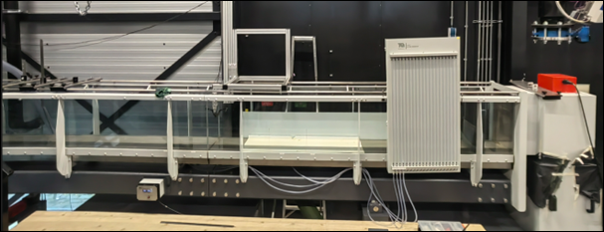
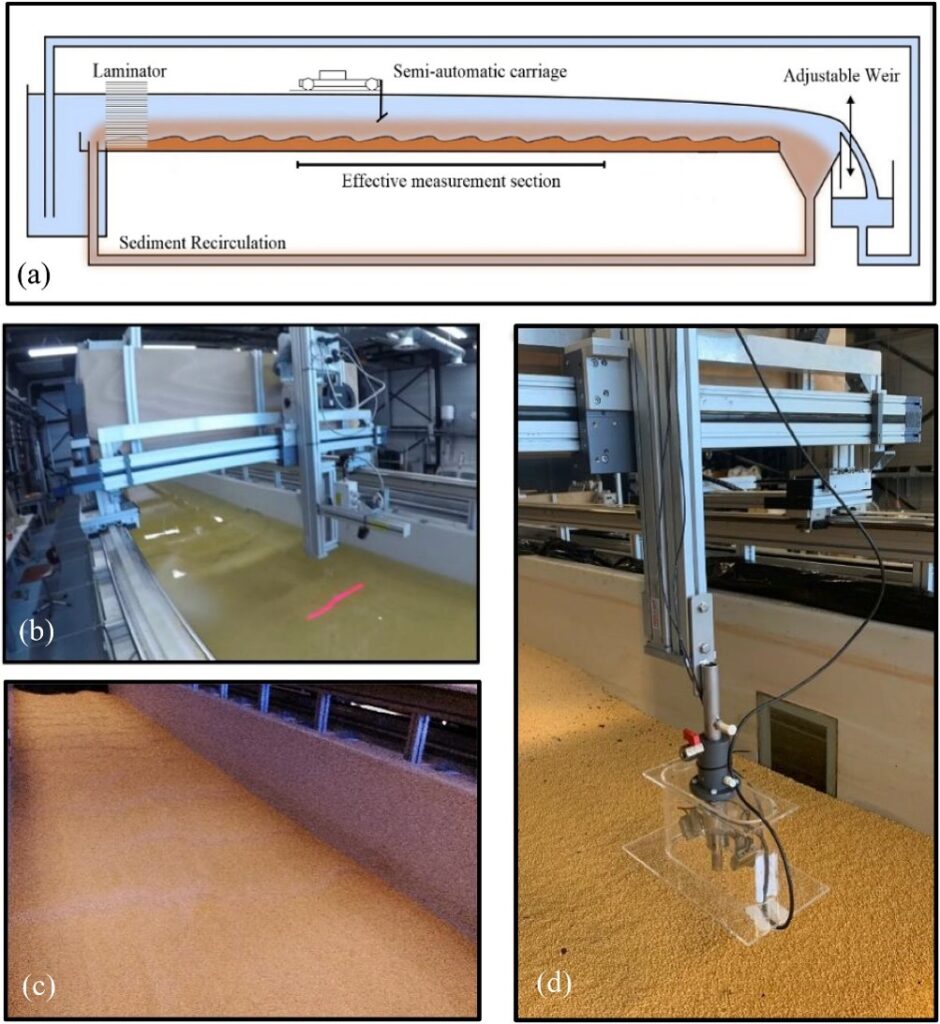
b) Sediment recirculation flume for physical scale modeling
This large-scale recirculating flume is designed for experimental studies of water and sediment transport in rivers and other open-channel systems, including prototype-scale physical modelling of fluvial processes. The facility features a 12.8 m-long, 2.6 m-wide channel with controlled flow and sediment recirculation, enabling investigations of channel morphodynamics, sediment transport, hydraulic structures, and river engineering interventions.
Advanced instrumentation, including acoustic velocimeters, laser-based bed scanning, sediment concentration sensors, bed profilers, and automated monitoring systems, supports high-resolution measurements of flow, sediment dynamics, bed morphology, and water-surface characteristics.
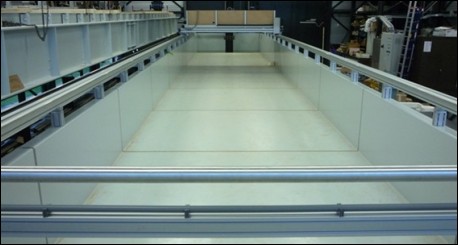
c) Sediment recirculation flume
This tilting recirculating flume is designed for experimental investigations of river morphodynamics, sediment transport, bedform development, and bank erosion processes under controlled hydraulic conditions.
The facility features a 14.4 m test reach within a 17.1 m-long channel, adjustable slopes up to 4%, and systems for recirculating both bedload and suspended sediment, enabling realistic simulations of fluvial processes at laboratory and prototype scales. Advanced instrumentation, including acoustic velocimeters, laser bed scanners, sediment concentration analysers, bed profilers, and automated monitoring systems, supports high-resolution measurements of flow dynamics, sediment transport, bed morphology, and hydraulic roughness.
How to apply?
Researchers interested in accessing the facility are invited to contact the designated contact person to discuss their research requirements and submit a proposal. Access is available to researchers from institutions other than the university hosting the facility.
Proposals should not exceed two pages and should clearly describe the scientific objectives, methodology, and expected outcomes of the proposed research. All proposals will be evaluated, and applicants will be notified of the outcome within two weeks of submission.
Successful applicants will be granted access to the facility’s laboratory equipment and infrastructure and will receive technical and scientific support throughout the access period.
What should be in a proposal?
A proposal should include a brief summary (maximum 150 words) and a project description (maximum two pages) addressing the following:
- Scientific background: Overview of the research topic and its significance.
- Research approach: Description of the proposed work, including sample details, required analyses and their justification, and the estimated analysis time.
- Innovation: Novel aspects of the research.
- Expected impact: How the proposed analyses will contribute to or advance the research objectives.